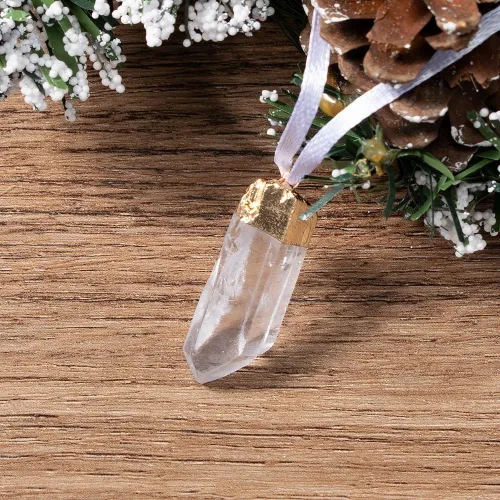
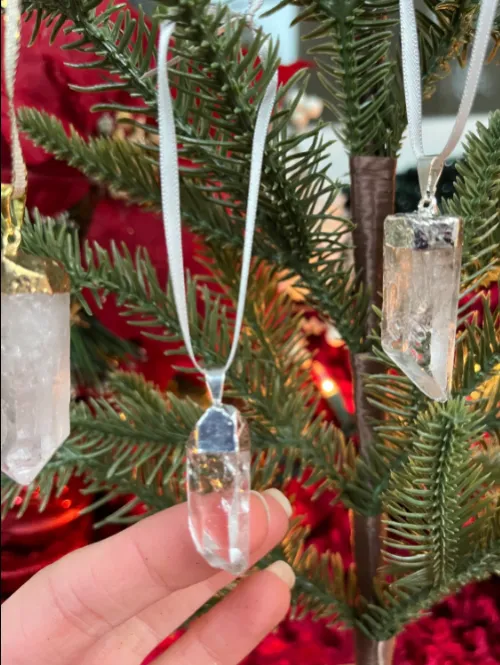
To beautifully showcase clear quartz on your Christmas tree, position pieces near light sources to amplify their natural sparkle through internal reflections and refraction while using secure wire-wrapping techniques that account for weight distribution. Strategically distribute clusters throughout branches based on your tree's density for visibility, and maintain optical clarity through regular dusting while choosing LEDs over traditional lights for safer yet brilliant illumination.
Unwrapping those delicate quartz ornaments always feels special, doesn't it? Maybe you’ve had that moment admiring one in your palm, wondering why some pieces seem to whisper while others shout. Well, it might be more than just candlelight playing tricks—clear quartz has this uncanny ability to make you pause and feel something. If you’ve found yourself instinctively reaching for a particular cluster year after year, well, that subtle pull might actually matter as much as where you hang it on your evergreen masterpiece.
What You’ll Discover
Optimal Techniques for Quartz Visibility
When your carefully hung quartz somehow disappears among branches or loses its spark by twilight, we’ve all experienced that decorating frustration. The magic lies not in piling on more ornaments, but in understanding how light moves around and through your crystals throughout the day.
By intentionally placing quartz near string lights—especially LEDs due to their cool operation—you allow light beams to enter the crystals, bounce internally, and refract into prismatic effects. Try hanging them near tree-top angel lights or within arm’s reach where bulbs concentrate. And don’t glue pieces in one spot forever! Being able to adjust crystal positions lets you harness both sunny windows in daytime and warm indoor lamps by night.
Morning vs Evening Positioning
Crystals facing eastward capture sunrise brilliance. Shift them westward as daylight fades to catch artificial glows.
Shadow Play Dynamics
Observe branch shadows at different hours; quartz pieces behind dense needles might need relocation for uninterrupted lighting.
Light Interaction with Quartz Crystal Properties
Ever wonder why quartz appears to glow differently under sunset versus tree lights? Much depends on its innate ability to gather external illumination and transform it internally.
That mesmerising sparkle isn’t random—high-quality clear quartz functions like nature’s amplifier through efficient light transmission. Its molecular structure essentially captures photons entering the crystal and redirects them toward your eyes. Rough, unpolished specimens create whimsical scattered bursts, while smoothly polished surfaces behave like tiny mirrors, projecting defined reflections across your room. When directed light hits the facets at precise angles, refraction occurs inside the crystalline lattice, splitting it into vivid colours around branches, almost like frozen fireworks suspended among evergreen needles.
Attachment Methods for Secure Placement
Nothing dampens holiday cheer faster than finding your favourite crystal face-down on the floor. Keeping pieces securely mounted while preserving their visual grace is essential.
Thicker jewellery wire works beautifully for wrapping points and clusters—it bends smoothly around branches while letting quartz dangle freely for omnidirectional viewing angles. Avoid narrow wires that may dig into tree limbs over time; these cause unnecessary damage that invites sagging. For pieces over 300g, balance their weight by hanging them near the trunk where sturdier branches emerge. If you’re suspending bigger stalactite formations, position them low where thick limbs can bear more load without bending.
Wire-Wrapping Guide
For medium-sized pieces:
- Cut 20-gauge copper wire 3 times the crystal’s height
- Loop at quartz midpoint; wrap ends around branch twice
- Twist wire ends inward to avoid snagging
Branch Safety Check
After placement, gently wiggle ornaments. If branch droops dramatically, reduce wire loops or relocate downward.
Practical Experience from Tree Decorating
Decorating a sparse artificial tree differs vastly from wrestling with a plush natural fir. These subtle practical nuances determine whether your quartz shines like captured starlight or gets swallowed.
Thick trees require extra spacing strategy since dense foliage can easily obscure quartz. We’ve found positioning pieces near the branch tips creates clearer visual lines outward. For sparse trees lacking natural volume, group smaller quartz clusters in trios at varying depths to create layered focal points. Remember to step back regularly while decorating—what appears centred from up close often sits awkwardly once viewed room-wide. That natural asymmetry you notice? Rather than fighting it, use it to create unexpected sparkle corridors drawing eyes across the tree.
Assessing Quartz Quality and Clarity
Did you know faint micro-scratches formed months ago could be dulling your crystal’s performance today? Quartz health directly impacts its ability to interact with lights.
Hold each piece toward any window; the cleaner the quartz, the less light diffusion occurs through subtle micro-scratches or dust accumulations. You’d be amazed how foggy fingerprints on polished points scatter beams. For restoration, gently wipe surfaces monthly with microfiber cloths while decorations remain in place. When selecting new specimens for your collection, examine surfaces under focused light—polished grades reflect crisp defined shapes while raw quartz creates more dispersed organic patterns. Neither is inherently better; but their light behaviour shifts accordingly.
Creative Approaches to Visual Impact
Why limit crystals to solo performances? Combining quartz with thoughtful partners unlocks stunning displays reflecting festive magic.
Introducing reflective accents near quartz acts as light multiplier—imagine silver stars placed diagonally opposite catching and redirecting glow through adjacent clusters. For particularly striking dynamics, position geometric metal ornaments behind larger points to serve as illuminated backdrops. Raw quartz fragments scattered asymmetrically among sparser branching regions create charming moments of unexpected brilliance as people move through the room. And don’t overlook negative space! Purposeful gaps surrounding key quartz accents make their ethereal light bursts feel almost choreographed against shadowed evergreen backdrops.
Letting Light Find You
There’s something quietly transformative about creating spaces where light dances freely. As we carefully situate these crystals, it can feel like arranging fragments of captured stardust—reminding us that clarity often arrives when we position ourselves where inner and outer illumination converge. The sparkle we seek externally often mirrors our innate capacity to reflect joy uniquely. When you step back admiring your completed tree, see it as more than decorations: it’s a testament to noticing fleeting glimmers amid daily rhythms. This holiday quiet may hold gentle invitations—an unwrapped moment of stillness where you recognise your own resilience reflecting back.
Addressing Common Display Questions
Decorating with delicate natural minerals invites practical and philosophical curiosities. Let’s clarify prevalent queries.
We’ve consistently found modern LED lighting enhances visible sparkle without heat risks plaguing vintage bulbs.
Q: Will quartz crack in cold rooms?
A: Crystalline stability remains unaffected by typical indoor winter temperatures; concerns arise mostly with sudden shifts like moving ornaments outdoors immediately after display.
Q: Can touching quartz diminish its shine?
A: Fingerprint oils gradually reduce surface refraction; gentle monthly cleaning maximizes sparkle retention.
Q: Why do photos make quartz look brighter than reality?
A: Camera lenses and artificial enhancement often exaggerate prism effects; appreciate their authentic subtle glow personally.


![White Crystal: Ultimate Guide to Benefits, Uses & Real vs Fake [2025]](https://www.clearquartzblog.com/cdn/shop/t/151/images/empty_bag.png?v=8.7428)
